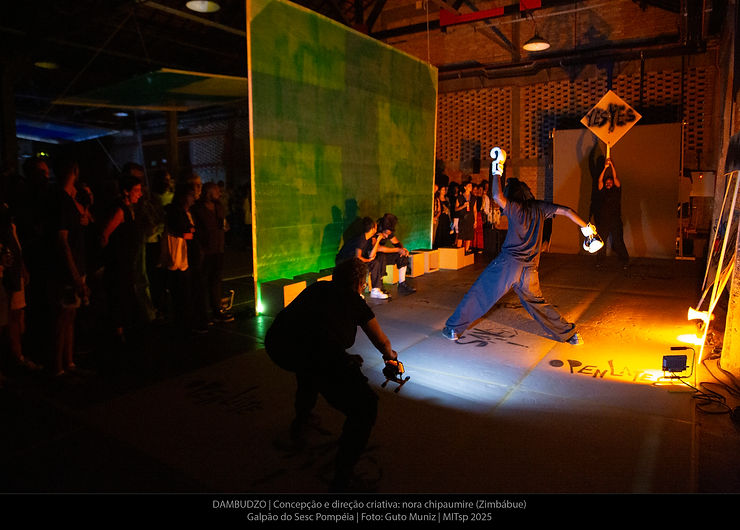
Dambudzo
nora chipaumire, creative direction & performer
Tatenda Chabarwa, performer
McIntosh Pedzisai “SOKO” Jerahuni, performer
Jonathan Kudakwashe Daniel, performer
Tyrone Isaac-Stuart, performer
Fatima Katiji, performer
Mohamed Yousry Fathy "Shika" Saleh, performer
Shamar Wayne Watt, performer
Joyce Delores Edwards, performer
Beauty Katiji, performer
Vusumuzi Moyo, sound engineer
Kwamina Biney, sound engineer
Heidi Eckwall, Technical Director
Soeren Kodak, Irene Paetzug, Technical Assistant & Stage Design
Laetitia Tshombe, Amélie Gaulier, Jay Beardsley, Project Management
Svenja Wichmann, Multimedia & Archiving
Franz Schütte, Sound Engineer Development
Kwadwo Owusu Ansah, Production Assistant
Johanna Rau, Studio Intern Berlin
Catalina Wortmann, Studio Intern Berlin
Mieke Ulfig, Video Production Berlin
Dambudzo is a bold, anti-genre collapse of sound, painting, sculpture, and performance. In Shona, dambudzo means “trouble,” and it is also the name of Zimbabwean writer Dambudzo Marechera, who, along with other radical African thinkers, inspires nora’s exploration of the relationship between knowledge and language shaped under colonial rule. A glorious celebration of radical African presences, Dambudzo shatters clichés, defies conventions, and opens new spaces that transcend the limitations of language, while the artists are embodying more subtle ways of communicating and being together.
Dambudzo is a conversation with Zimbabwe’s enfant terrible Dambudzo Marechera and the Bhundu Boys, a band that captivated the youth with JIT, a hopeful, bright sound that has since waned under the pressures of capitalist and colonial legacies.
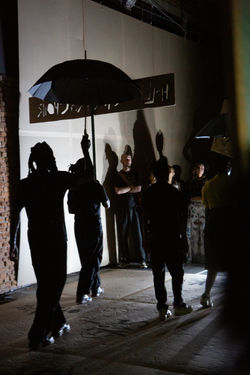
Large-scale paintings on plastic allow the performance space to shift between intimate and public configurations. The house built by Dambudzo—a “house of hunger,” or shabini—brings together neighborhood residents who live each minute with zest and abandon. Beauty, love, and violence are spoken in one breath; the street enters the house, and the house is the street.
The humans who populate the house are musicians, revolutionaries, tricksters, and sellouts. Constant reminders of empire and settler colonialism resonate throughout the work, punctuated by the sound of barking Rhodesian ridgebacks.
 |  |  |  |  |  |
|---|---|---|---|---|---|
 |  |  |  |  |  |